
PM E-DRIVE Scheme 2026: Electric 3-Wheeler Subsidy, Eligibility & How to Claim
PM E-DRIVE Scheme 2026: Electric 3-Wheeler Subsidy, Eligibility & How to Claim
E-Rickshaw Loan & Financing Guide — Documents, Eligibility, EMI
E-Rickshaw Loan & Financing Guide — Documents, Eligibility, EMI
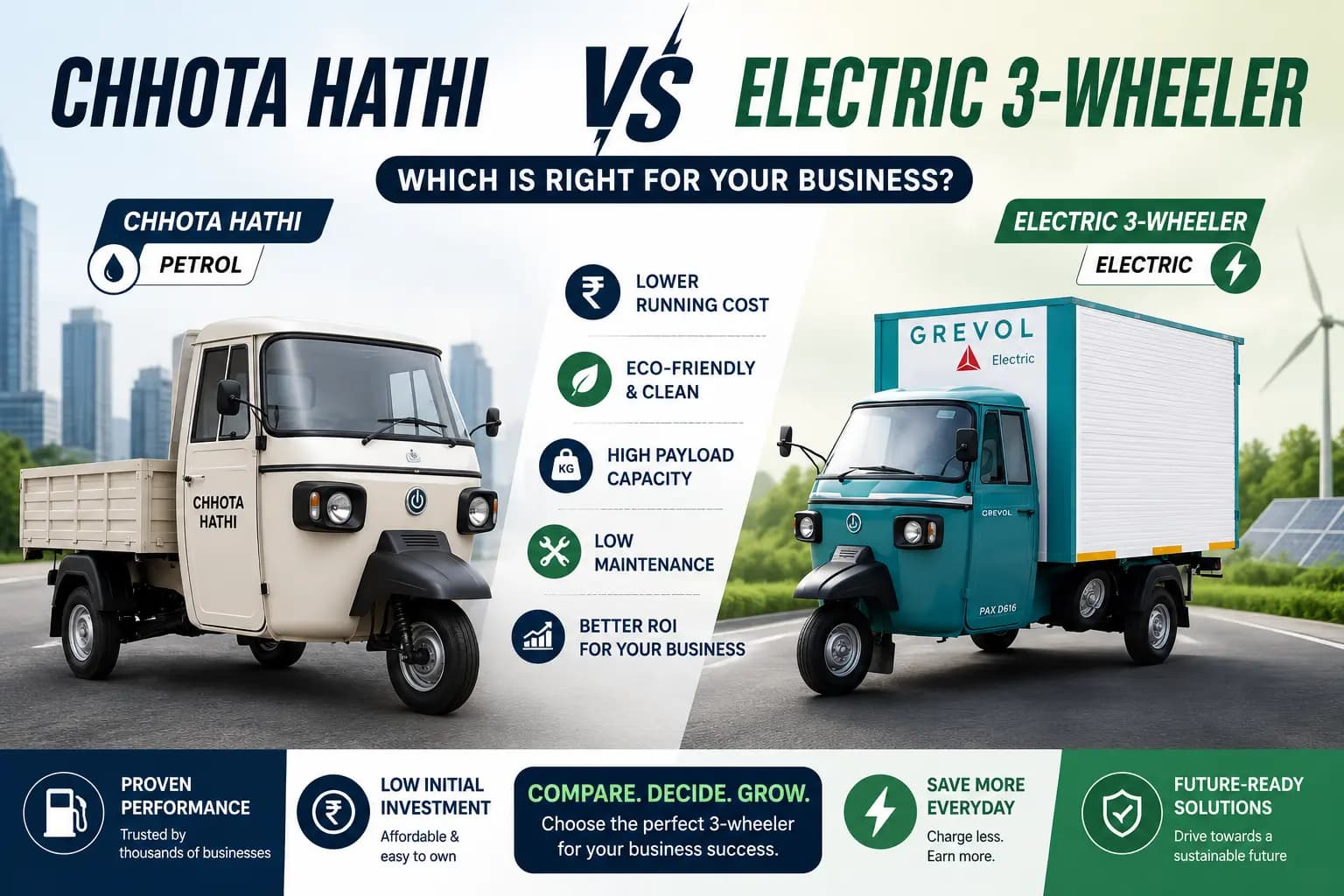
Chhota Hathi Price vs Electric 3-Wheeler: What Should a Business Buy?
When business owners search for Chhota Hathi price, they are usually not looking for a vehicle merely for personal transportation.
They are looking for a tool that can generate revenue.
The comparison between a traditional mini goods vehicle and an electric three-wheeler should therefore go beyond purchase price.
The real question is:
Which vehicle can transport my goods at the lowest reliable cost?
Where does the Chhota Hathi fit?
Traditional mini trucks are popular because they offer:
- Familiarity
- Established service networks
- Higher availability of mechanics
- Established resale markets
- Conventional fuel infrastructure
They can be a strong choice for businesses that need a proven ICE platform.
But the cost of fuel and maintenance can become significant for high-utilisation routes.
Why are businesses considering electric 3-wheelers?
Electric three-wheelers are particularly relevant for:
- Last-mile delivery
- Local distribution
- Grocery movement
- Parcel delivery
- Market supply
- Small business logistics
- Repeated urban routes
Their strongest advantage is often not maximum range.
It is predictable low-cost operation.
Compare the right numbers
Create a simple table for your business.
| Factor | Traditional mini truck | Electric 3-wheeler |
|---|---|---|
| Purchase cost | Check quotation | Check quotation |
| Fuel/energy | Diesel | Electricity |
| Routine maintenance | Higher drivetrain complexity | Simpler EV drivetrain |
| Charging | Not applicable | Required |
| Payload | Model dependent | Model dependent |
| Daily range | Model dependent | Model dependent |
| Financing | Compare EMI | Compare EMI |
| Route restrictions | Check current rules | Check current rules |
| Government support | Category dependent | Policy dependent |
| Best use | Longer/unpredictable duty | Urban predictable duty |
A simple running-cost example
Imagine your business runs:
100 km per day
for:
26 days per month
That equals:
2,600 km per month
or:
31,200 km per year
At that utilisation, energy cost becomes extremely important.
Even a ₹3/km difference corresponds to:
₹93,600 per year
A ₹5/km difference corresponds to:
₹1,56,000 per year
These examples are only illustrations. Use your actual fuel, tariff and vehicle efficiency.
What about payload?
Never choose an EV simply because it has lower operating cost.
Your vehicle must handle your business.
Check:
- Rated payload
- Body dimensions
- Wheelbase
- Ground clearance
- Gradeability
- Range at payload
- Charging time
- Warranty
A vehicle that saves ₹500 per day but cannot complete your route is not economical.
What about Delhi?
Delhi is moving toward stronger electrification of commercial vehicles.
Under Delhi EV Policy 2026, new registrations in applicable three-wheeler and N1 goods-vehicle categories are moving toward electric-only registration from 1 January 2027.
That makes the electric option increasingly relevant for buyers planning their next vehicle.
When should you choose an electric 3-wheeler?
An electric 3-wheeler is particularly worth considering when:
- Most work happens inside a city
- Daily distance is predictable
- The vehicle returns home or to a depot regularly
- Charging is available
- Fuel is a major operating expense
- The business wants predictable running costs
When should you consider a conventional mini truck?
A conventional vehicle may still make more sense when:
- The route is highly unpredictable
- Charging infrastructure is unavailable
- High-speed highway travel is frequent
- Payload exceeds available EV configurations
Final takeaway
The right vehicle is determined by your business route, not by brand familiarity alone.
Use the traditional vehicle as the benchmark.
Then compare it against an electric 3-wheeler using:
Total cost per kilometre + monthly EMI + downtime + maintenance + usable payload
That is how you make a commercial vehicle decision based on business economics.
Explore Grevol cargo solutions: /cargo/
Recent Posts
Discover more articles here