
E-Rickshaw Loan & Financing Guide — Documents, Eligibility, EMI
E-Rickshaw Loan & Financing Guide — Documents, Eligibility, EMI
EV Charging Station Cost & Setup Guide for Fleet Owners
EV Charging Station Cost & Setup Guide for Fleet Owners
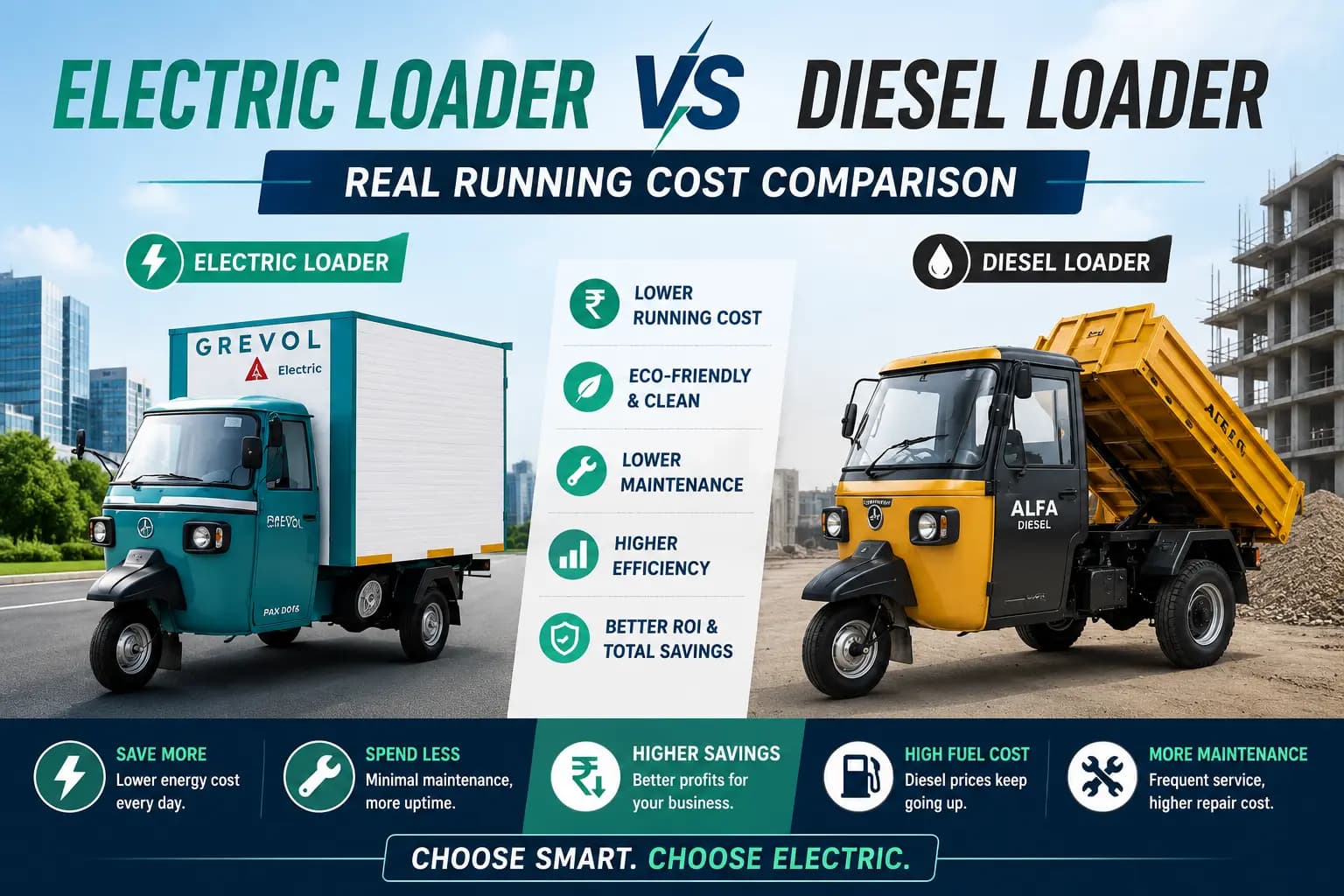
Loader Auto Price Is Only One Part of the Real Cost
When searching for loader auto price, most buyers naturally focus on the amount printed on the quotation.
But for a commercial vehicle, the purchase price is only the beginning.
A loader earns money when it moves goods.
Therefore, the better question is:
How much will this vehicle cost me over three to five years?
That is where electric and diesel loaders can look very different.
Compare the complete cost
For a commercial loader, calculate:
Total Cost of Ownership = Purchase + Financing + Energy + Maintenance + Insurance − Incentives − Resale value
Let’s break that down.
1. Purchase price
A diesel loader may have a familiar upfront price.
An electric loader may cost differently depending on battery capacity, motor, payload, body configuration and manufacturer.
Do not make a purchase decision based solely on the sticker price.
2. Fuel vs electricity
This is usually the biggest operating-cost difference.
For a diesel vehicle:
Daily fuel cost = Daily kilometres ÷ km/litre × diesel price
For an EV:
Daily electricity cost = Daily kilometres × kWh/km × electricity tariff
For high-mileage commercial vehicles, the difference can become significant over hundreds of operating days.
Example
Suppose a vehicle covers:
100 km per day
and operates:
26 days per month
That’s:
2,600 km per month
or approximately:
31,200 km per year
Even a relatively small difference in operating cost per kilometre becomes meaningful at that mileage.
For example, a difference of ₹2 per kilometre translates to approximately:
₹62,400 per year
At ₹4 per kilometre:
₹1,24,800 per year
At ₹5 per kilometre:
₹1,56,000 per year
These are illustrations; your actual savings depend on your electricity tariff, vehicle efficiency and diesel price.
3. Maintenance
A conventional diesel vehicle has multiple systems that require regular servicing.
An EV has fewer moving drivetrain components.
Potential maintenance differences may include:
- Engine oil
- Oil filters
- Engine servicing
- Exhaust components
- Clutch-related components
- Transmission components
Electric vehicles still require tyres, brakes, suspension, cooling systems and other maintenance.
So the correct statement is not “EVs require no maintenance.”
It is:
EV drivetrain maintenance can be simpler than an ICE drivetrain.
4. Battery cost
This is one area every EV buyer should investigate before purchasing.
Ask:
- Battery warranty?
- Battery chemistry?
- Warranty period?
- Warranty conditions?
- Replacement process?
- Battery serviceability?
- Expected useful life?
A cheap EV with an unclear battery policy can be more expensive than a slightly more expensive vehicle backed by stronger after-sales support.
5. Downtime
For a business, downtime is expensive.
Suppose a vehicle normally earns ₹1,500 per day.
If an unexpected breakdown causes five days of downtime:
Lost revenue = ₹7,500
And that excludes repair costs.
Therefore, reliability and after-sales support should be included in TCO.
6. Financing
A vehicle’s EMI affects monthly cash flow.
Compare:
Monthly EMI + running cost + maintenance
rather than EMI alone.
This is particularly important for owner-drivers who depend on their vehicle for daily income.
Which loader is better?
There is no universal answer.
An electric loader can be particularly attractive when:
- Daily kilometres are high
- Routes are predictable
- Depot charging is available
- The vehicle operates regularly
- Fuel savings matter
- Maintenance downtime must be reduced
A diesel loader can still make sense for applications where:
- Long-distance routes are unpredictable
- Charging is unavailable
- Heavy-duty operation exceeds the EV’s capability
- The vehicle frequently operates outside established charging networks
Recent Posts
Discover more articles here