
No previous article
No previous article
PM E-DRIVE Scheme 2026: Electric 3-Wheeler Subsidy, Eligibility & How to Claim
PM E-DRIVE Scheme 2026: Electric 3-Wheeler Subsidy, Eligibility & How to Claim
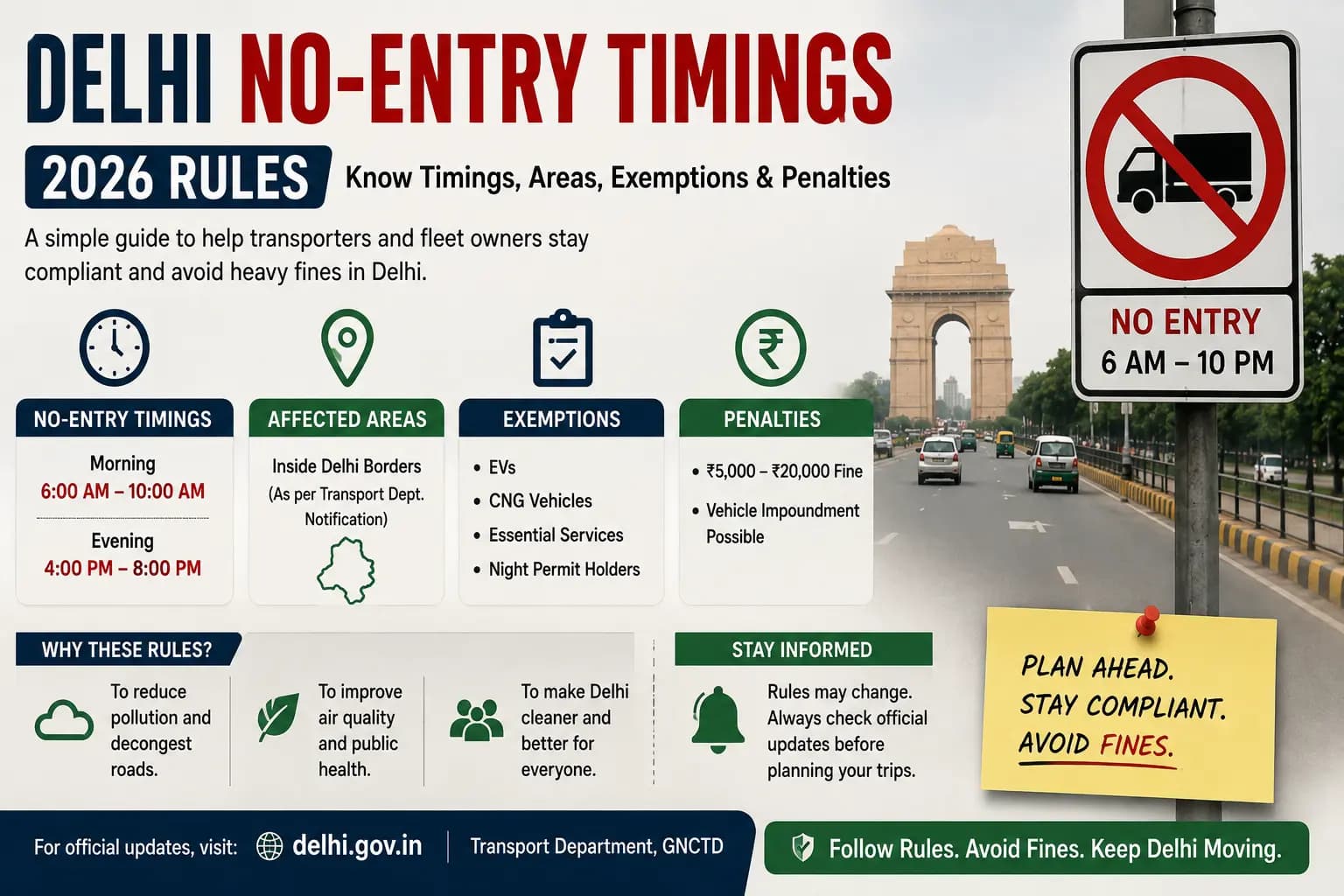
If you operate a commercial vehicle in Delhi, there is no single no-entry timing that applies to every vehicle and every road. Restrictions depend on the vehicle category, route and specific traffic notification. For goods vehicles, Delhi has restrictions covering specific roads and areas during daytime, peak hours and, in some cases, the entire day.
Source: Delhi Government Economic Survey 2025–26; Delhi Traffic Police
No-Entry Timings in Delhi: At a Glance
For HGVs, MGVs and LGVs, Delhi’s 2024 notification standardised the following timings where the relevant daytime or peak-hour restrictions apply:
| Type of restriction | Timing |
| Daytime restriction | 7:00 AM – 11:00 PM |
| Peak-hour restriction | 7:00 AM – 11:00 AM & 5:00 PM – 11:00 PM |
| 24-hour restriction | Applies on specific roads/areas |
| Other timings | May apply under route-specific notifications |
These timings should not be treated as a blanket Delhi-wide ban. The applicable restriction depends on the particular road, vehicle category and notification governing that route.
Source: Delhi Traffic Police — Gazette Notification on restriction timings; Delhi Government Economic Survey 2025–26
Which Commercial Vehicles Are Affected?
Delhi’s restrictions can apply to heavy goods vehicles (HGVs), medium goods vehicles (MGVs) and light goods vehicles (LGVs). Separate notifications specify which vehicle categories are restricted on particular roads and during which hours.
This means a commercial vehicle operator should check three things before planning a route:
Vehicle category → Road/area → Applicable timing
A route that restricts an LGV, for example, may not necessarily impose the same restriction on a different vehicle category.
Source: Delhi Traffic Police — Commercial Vehicle Restrictions & Notifications
Are 3-Wheeled Cargo Vehicles Exempt?
This is particularly relevant if you operate or are considering a 3-wheeler cargo vehicle.
Some Delhi route-specific notifications explicitly exclude 3-wheeled light goods vehicles from the restriction. For example, restrictions on Agra Canal Road and certain other specified routes apply to HGVs, MGVs and LGVs while expressly excluding 3-wheeled light goods vehicles.
However, this does not mean every 3-wheeler can enter every restricted road at every time. The exemption has to be read against the exact vehicle category and the specific notification applicable to that road.
Source: Delhi Traffic Police — Gazette Notification dated 4 November 2022
Electric Commercial Vehicles: What Changes in 2026?
Delhi’s Electric Vehicles Policy 2026, effective from 1 July 2026, introduces a specific no-entry benefit for a limited number of electric trucks.
The policy provides a 10-year exemption from no-entry timing restrictions for the first 1,000 privately owned electric N2 trucks that are purchased and registered in Delhi within three months from the policy notification date, subject to the policy conditions.
This exemption is not a blanket exemption for all electric commercial vehicles. It specifically applies to qualifying N2 electric trucks covered by the policy. So an operator should not assume that simply switching from a petrol/diesel vehicle to an EV removes every Delhi entry restriction.
Source: Delhi EV Policy 2026 — Delhi Transport Department / Delhi Gazette
Do You Need a Commercial Vehicle Entry Permit?
If your commercial vehicle needs to enter a restricted road or area during a prohibited period, Delhi Traffic Police provides an entry-permission process.
For a short-term requirement, operators can approach the concerned ACP/Traffic (District) and provide the reason for requiring entry during the restricted time or location.
For long-term entry permission, Delhi Traffic Police lists essential-service vehicles such as those transporting LPG, petroleum products, vegetables and milk. The application requires documents including:
- Pollution Certificate
- Fitness Certificate
- Registration Certificate
- Commercial Vehicle Permit
- Tax-paid receipt
- Insurance
- Work contract
- Previous permission/sticker, where applicable
The required route, timing and duration of the requested permission must also be specified.
Source: Delhi Traffic Police — Commercial Vehicle Entry Permission
How to Check If Your Vehicle Can Enter Delhi
Before starting a commercial trip, check:
1. Identify your vehicle category
Is it an HGV, MGV, LGV, 3-wheeler light goods vehicle or another category?
2. Check your route
Restrictions are often road-specific, rather than one rule for the entire city.
3. Check the applicable timing
Look for daytime, peak-hour or 24-hour restrictions.
4. Check exemptions
Some notifications specifically exclude certain vehicle categories, including 3-wheeled light goods vehicles on particular routes.
5. Check whether you need permission
If your trip falls within a restricted period, check whether short-term or long-term entry permission is available.
Why No-Entry Rules Matter When Choosing a Commercial Vehicle
For a commercial operator, a vehicle’s usable operating window directly affects how many trips or deliveries it can complete.
That makes route access and no-entry restrictions an important part of vehicle selection—not just a traffic-compliance issue.
For example, when comparing cargo vehicles, look beyond purchase price and consider:
Operating hours → Route access → Deliveries/day → Running cost → Total operating cost
For businesses operating mainly within Delhi, a vehicle with fewer applicable route restrictions can potentially provide greater operating flexibility. But the exact benefit depends on the vehicle category and routes you actually use.
Explore cargo vehicles or compare available models through vehicle comparison pages.
2026 Delhi Commercial Vehicle Checklist
Before buying or operating a commercial vehicle in Delhi, ask:
✓ What category is my vehicle?
✓ Does my regular route have a no-entry restriction?
✓ What are the restricted hours on that route?
✓ Does my vehicle qualify for a route-specific exemption?
✓ Do I need short-term or long-term entry permission?
✓ If I’m considering an EV, does a specific EV exemption apply to my vehicle category?
For financing the purchase, see Finance options.
The Bottom Line
There is no single “no-entry timing in Delhi” applicable to every commercial vehicle. The commonly standardised timings for HGVs, MGVs and LGVs are 7 AM–11 PM for daytime restrictions and 7 AM–11 AM plus 5 PM–11 PM for peak-hour restrictions, but specific roads can have different or additional restrictions.
For 3-wheeler operators, the distinction is important: some Delhi notifications specifically exclude 3-wheeled light goods vehicles, while the 2026 Delhi EV Policy provides a separate, tightly defined 10-year no-entry exemption for the first 1,000 qualifying private N2 electric trucks.
Before buying a commercial vehicle, check the combination of vehicle category + route + timing + exemption. That is more reliable than assuming that all commercial vehicles—or all EVs—follow the same Delhi no-entry rule.
Sources: Delhi Traffic Police; Delhi Transport Department; Delhi Government Economic Survey 2025–26; Delhi EV Policy 2026.
Recent Posts
Discover more articles here