
No previous article
No previous article
PM E-DRIVE Scheme — Eligibility, Benefits & How to Claim
PM E-DRIVE Scheme — Eligibility, Benefits & How to Claim
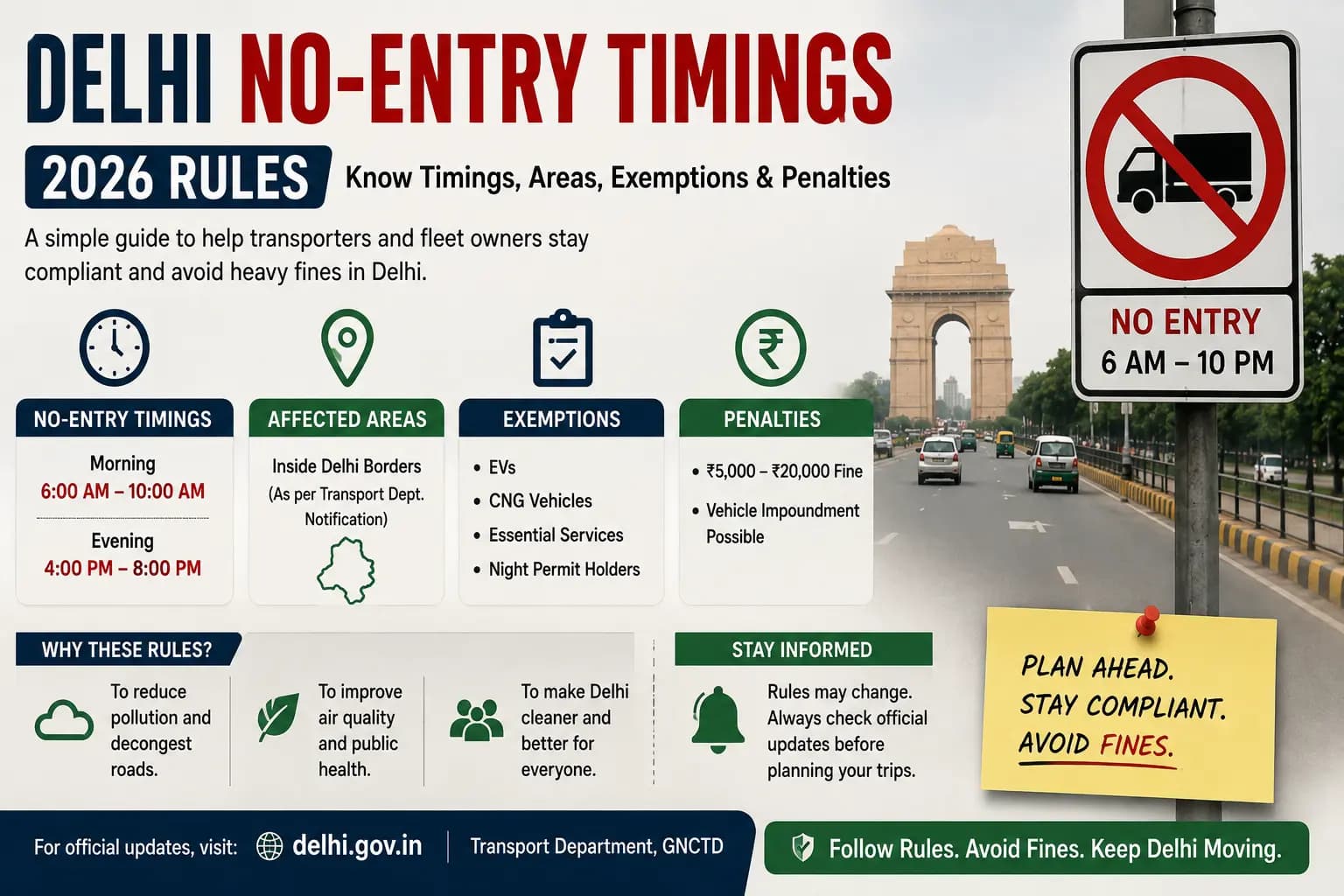
No Entry Timing in Delhi: Commercial Vehicle Rules Every Operator Should Know
If you operate a commercial vehicle in the capital, understanding no entry timing in Delhi is essential. A vehicle that is perfectly legal to operate during one part of the day may face restrictions during another period or on a particular road. The important thing to understand is that Delhi does not have one universal no-entry timing covering every commercial vehicle, every road and every situation.
Restrictions can vary according to vehicle category, location, route, traffic orders and special air-quality measures.
Delhi Traffic Police maintains a dedicated no-entry permission service and publishes traffic notifications, while violations of applicable no-entry restrictions can attract significant penalties.
Why do Delhi commercial vehicles face no-entry restrictions?
No-entry restrictions are primarily intended to manage:
- Traffic congestion
- Peak-hour vehicle movement
- Pollution
- Freight movement through dense markets
- Road capacity
- Major events and temporary traffic arrangements
For commercial operators, these rules can have a direct impact on productivity.
A vehicle that cannot legally enter an area during the customer’s preferred delivery window can lose productive hours.
Is there one no-entry timing for all of Delhi?
No.
This is one of the biggest misconceptions surrounding Delhi commercial vehicle restrictions.
Specific restrictions can apply to specific roads, markets, vehicle classes or situations.
For example, a Delhi High Court proceeding concerning the Karol Bagh area recorded restrictions involving commercial-vehicle entry and loading/unloading, including directions relating to prohibition during particular hours. The court record specifically discussed commercial-vehicle entry between 7 AM and 10 PM in that context, rather than establishing one universal rule for every road in Delhi.
Therefore, operators should never assume that a timing found online automatically applies to every Delhi route.
How should a fleet operator check the correct timing?
Before planning a route, check:
Vehicle category
A small electric cargo vehicle, LCV, HMV and N2 truck may not be treated identically.
Route
Restrictions can be road-specific or area-specific.
Traffic notifications
Delhi Traffic Police periodically issues notifications changing or imposing restrictions.
Air-quality conditions
During severe pollution episodes, additional restrictions can be introduced.
During earlier GRAP restrictions, Delhi orders have specifically exempted categories such as electric trucks and certain EVs from particular entry prohibitions.
Why are EVs becoming more attractive for Delhi logistics?
Delhi’s EV policy is increasingly linking electrification with commercial mobility.
The Delhi EV Policy 2026 provides a special ten-year no-entry exemption for the first 1,000 qualifying private N2 electric trucks purchased and registered within three months of the policy notification.
That is particularly valuable for a logistics operator.
Imagine two vehicles serving the same customer:
Vehicle A: Diesel
Vehicle B: Electric
If Vehicle A cannot access the route during the required delivery window, the business may need to maintain more vehicles to achieve the same service level.
Vehicle B may have greater operational flexibility where the applicable exemption or restriction permits it.
That flexibility has economic value.
No-entry restrictions can affect your real vehicle cost
Suppose a commercial vehicle generates revenue for eight working hours per day.
If traffic restrictions remove two productive hours, the vehicle isn’t simply consuming fuel while sitting idle.
It is also losing revenue-generating time.
That is why commercial vehicle TCO should include:
Cost per kilometre + maintenance + financing + downtime + route accessibility
This is especially important for businesses that make multiple deliveries each day.
Do electric vehicles have unrestricted access everywhere?
No.
This is another important distinction.
Buying an EV does not automatically mean that every road or zone becomes accessible at every time.
Specific exemptions depend on the relevant policy, vehicle category and notification.
Operators should verify the exact applicable restriction before relying on an exemption for a commercial route.
Practical checklist before buying a commercial EV
Before finalising your vehicle, document your typical routes.
For every major route record:
- Entry location
- Delivery location
- Preferred delivery time
- Vehicle category
- Current restriction
- Alternative route
- EV eligibility
- Charging location
- Approximate daily kilometres
Then calculate whether switching to an EV changes your operational availability.
Final takeaway
No-entry rules are not simply a traffic issue.
For a commercial fleet, they are a business-cost issue.
A vehicle that can complete more deliveries in your operating window can be more valuable than a vehicle with a lower purchase price. That is why route planning, regulatory access and energy cost should all be considered before selecting your next commercial vehicle.
Recent Posts
Discover more articles here