
Delhi No-Entry Timings for Commercial Vehicles — 2026 Rules
Delhi No-Entry Timings for Commercial Vehicles — 2026 Rules
Chhota Hathi vs Electric 3-Wheeler — Which Is Right for Your Business?
Chhota Hathi vs Electric 3-Wheeler — Which Is Right for Your Business?
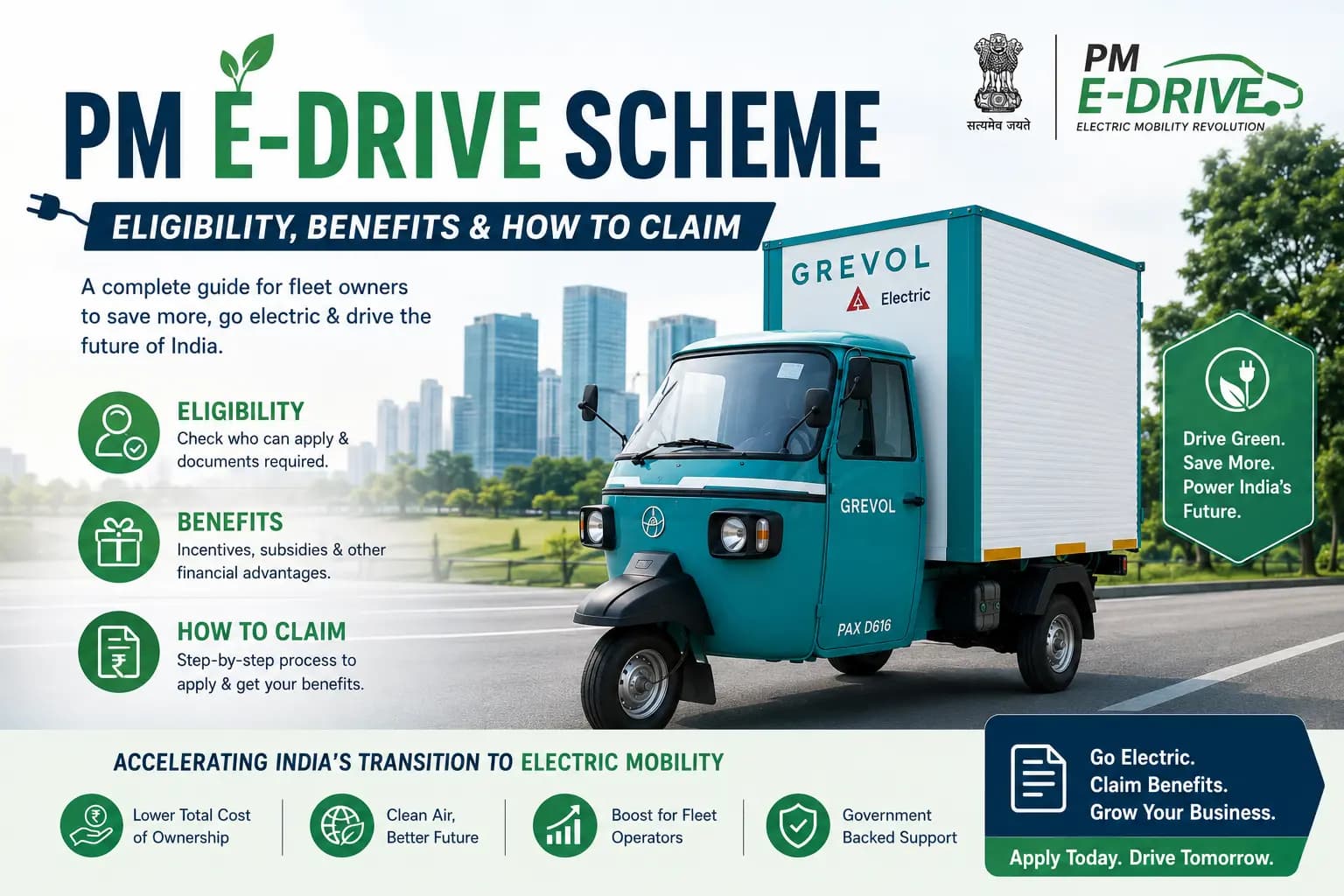
PM E-DRIVE Scheme: Complete Guide for EV Buyers in 2026
The PM E-DRIVE Scheme is one of India’s major central-government initiatives supporting electric mobility. But understanding the scheme in 2026 requires care because its duration has been extended and different EV categories have different eligibility and terminal dates.
The Ministry of Heavy Industries originally launched PM E-DRIVE in 2024. The scheme has subsequently been extended to 31 March 2028 for various segments, while some vehicle categories have separate terminal dates.
What is PM E-DRIVE?
PM E-DRIVE stands for:
PM Electric Drive Revolution in Innovative Vehicle Enhancement
The scheme is designed to accelerate electric mobility through financial incentives, EV charging infrastructure and support for emerging vehicle categories.
Covered categories include:
- Electric two-wheelers
- Electric three-wheelers
- Electric ambulances
- Electric trucks
- Electric buses
- Public charging infrastructure
- Testing-agency upgrades
Is every EV eligible?
No.
This is extremely important.
Eligibility depends on:
- Vehicle category
- Battery technology
- Manufacturing requirements
- Registration date
- Scheme validity
- Approved model status
- Applicable operational guidelines
For example, the official PM E-DRIVE FAQ states that e-3Ws are eligible only for commercial use, while certain eligibility rules differ for e-2Ws.
What are e-vouchers?
PM E-DRIVE uses an electronic voucher process for applicable demand incentives.
At the time of an eligible purchase, the scheme portal can generate an e-KYC/Aadhaar-authenticated e-voucher, with a link sent to the registered mobile number.
This means buyers should pay attention to the documentation and verification process instead of assuming that a subsidy is simply deducted from every EV invoice.
What vehicles are covered?
The scheme supports multiple segments.
For example, the official portal lists support for electric three-wheelers, e-trucks and other categories. For e-trucks, eligible vehicles fall into N2 and N3 categories, and the incentive calculation is linked to battery capacity, ex-factory price and GVW conditions.
The important lesson:
Do not evaluate eligibility based on the words “electric vehicle” alone.
The vehicle must satisfy the conditions applicable to its specific segment.
What about e-rickshaws and electric three-wheelers?
PM E-DRIVE includes registered e-rickshaws/e-carts and certain electric three-wheelers.
The official scheme states that these vehicles are generally required to be used for commercial purposes and equipped with qualifying advanced batteries.
However, scheme amendments and terminal dates have changed over time.
The official notifications page currently shows multiple amendments and extensions, which is why older articles can be misleading.
Is FAME II still the subsidy to apply for?
No.
FAME II was the predecessor policy framework. PM E-DRIVE is the current central scheme.
Therefore, a buyer searching for “FAME 2 subsidy” should check current PM E-DRIVE eligibility rather than assuming an old FAME II incentive still applies.
How does a buyer verify eligibility?
Before booking an EV, ask the dealer or OEM for:
- 1.Vehicle approval status
- 2.Applicable government scheme
- 3.Current incentive amount
- 4.Eligibility conditions
- 5.Required documents
- 6.Registration requirements
- 7.Voucher/claim procedure
- 8.Expected processing timeline
Do not rely on a generic “government subsidy available” statement.
Delhi buyers should also check state benefits
A Delhi buyer can potentially encounter two separate policy layers:
Central: PM E-DRIVE
State: Delhi EV Policy 2026
These should not be treated as automatically interchangeable.
Delhi’s own policy contains separate purchase incentives and exemptions for eligible categories.
What documents should you keep?
Maintain:
- Aadhaar or applicable identity document
- Registered mobile number
- PAN where required
- Purchase invoice
- Vehicle registration certificate
- Bank details
- Insurance
- Scrapping documentation if applicable
- E-voucher details
- Dealer/OEM documents
The exact list can vary by incentive.
Final takeaway
Government incentives can reduce the effective cost of an EV, but they should never be the only reason to buy one.
The better calculation is:
Effective EV cost = Purchase price − eligible incentives + financing + charging + operating costs
Then compare that number with the conventional alternative. For a commercial buyer, operational savings over several years can be considerably more important than the initial subsidy.
Recent Posts
Discover more articles here