
Electric Loader vs Diesel Loader — Real Running Cost Comparison
Electric Loader vs Diesel Loader — Real Running Cost Comparison
No upcoming article
No upcoming article
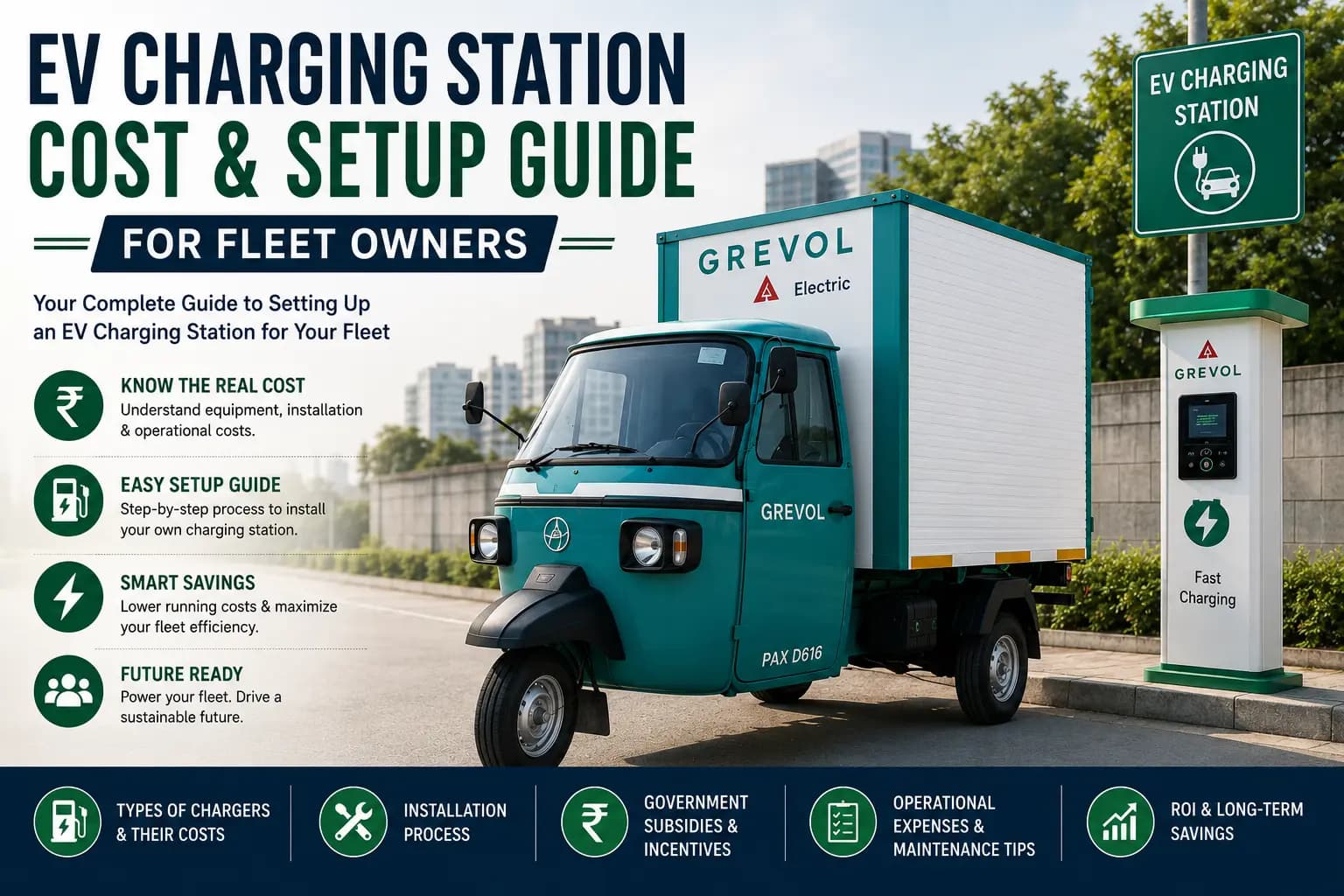
EV Charging Station Cost: What Fleet Owners Actually Need to Budget
The biggest mistake fleet operators make when estimating EV charging station cost is to calculate only the price of the charger.
A charger is just one component.
The actual cost can include electrical infrastructure, cabling, panels, transformer capacity, civil work, networking, software, land, maintenance and installation.
For a commercial fleet, the right charging system is therefore less about buying the most powerful charger and more about matching charging capacity to your daily operation.
What determines charging station cost?
The biggest factors are:
Charger power
A basic AC charger costs much less than a high-power DC charger.
Indicative 2026 market ranges show single AC chargers starting around the lower end of the infrastructure spectrum, while 30–60 kW DC chargers can run into several lakh rupees before complete site infrastructure is added.
Electrical infrastructure
This may include:
- New electrical connection
- Load enhancement
- Transformer
- Distribution panel
- Cables
- Protection equipment
- Earthing
- Metering
In some projects, the power infrastructure can cost as much as or more than the charger itself.
Civil work
Depending on the location, you may require:
- Foundation
- Parking bays
- Canopy
- Cable protection
- Signage
- Drainage
- Lighting
- Security
Software and networking
Commercial charging stations may need:
- Payment integration
- Charger management software
- Remote monitoring
- User authentication
- Usage reporting
- Fleet management
Indicative 2026 cost ranges
Market estimates vary considerably by site and vendor.
As a broad planning reference:
| Setup | Indicative range |
|---|---|
| Single AC charger | ~₹1 lakh and upward |
| Small AC station | ~₹5–12 lakh |
| 30–60 kW DC setup | ~₹12–30 lakh including infrastructure in many cases |
| Mixed AC + DC commercial setup | ~₹9–18 lakh |
| Large multi-bay hub | Can exceed ₹15 lakh significantly |
These are planning ranges, not quotations. Actual cost depends heavily on electrical load, land and site requirements.
AC vs DC charging
AC charging
Best suited for:
- Overnight depot charging
- Employee parking
- Small commercial fleets
- Vehicles that are parked for several hours
The biggest advantage is lower infrastructure cost.
DC charging
Best suited for:
- High-utilisation fleets
- Public charging
- Highway operations
- Fleets that need rapid turnaround
The trade-off is higher infrastructure cost.
What does a small commercial fleet actually need?
Suppose a fleet operates 10 electric cargo vehicles.
Each vehicle returns to the depot at 7 PM and leaves at 7 AM.
You don’t necessarily need an extremely high-powered DC charger.
A slower AC charging system may be enough because the vehicles have a long charging window.
But imagine the same fleet operating two shifts.
Now charging time becomes a bottleneck.
You may need faster charging or additional charging points.
Therefore:
Charging requirement = Fleet size × energy requirement × operating schedule
Home or depot charging vs public charging
For commercial operators, depot charging is often easier to control.
You know:
- Where the vehicle returns
- When it returns
- How much energy it consumed
- When it leaves again
Public charging is useful when vehicles spend long periods away from base.
The best commercial strategy can therefore be a hybrid:
Depot charging + strategic public charging
What should you check before installing?
Before signing a charger contract, confirm:
- Available electrical load
- Required sanctioned load
- Transformer requirement
- Charger compatibility
- Cable length
- Safety protection
- Earthing
- Network connectivity
- Payment system
- Warranty
- AMC
- Spare parts availability
- Software support
Government guidance also makes clear that EV charging-station cost is not merely hardware; installation involves land, equipment, electricity infrastructure and other operating components.
Calculate cost per kilometre
Fleet operators should not stop at charging-station cost.
Calculate:
Energy cost per km = Electricity price × kWh consumed per km
Then compare:
EV operating cost per km
against:
Diesel/petrol operating cost per km
This is where commercial EVs can become financially attractive.
Final takeaway
There is no single EV charging station cost that works for every fleet.
The cheapest charging system is not necessarily the best one.
The right system is the one that keeps your vehicles ready for work without unnecessary capital expenditure.
Explore Grevol cargo vehicles: /cargo/
Recent Posts
Discover more articles here